Carlisle Utd FC
Brunton Park,
Warwick Rd,
Carlisle,
CA1 1LL

Carlisle United’s crest, adopted in 1995, is based on the city’s coat of arms. The red wyverns flanking the shield represent the ancient Kingdom of Cumbria, while the motto below – “Be Just and Fear Not” – is taken from Cardinal Wolsey’s speech to Thomas Cromwell in Shakespeare’s Henry VIII.
Earlier club badges featured a fox, reflecting Carlisle’s traditional nickname, the Foxes, linked to the region’s hunting heritage and the legendary huntsman John Peel. Though now more commonly known as the Cumbrians, the fox remained a club symbol for decades. A long-running matchday ritual once saw mascot Olga the Fox parade a mounted, taxidermied fox before kick-off. This ended in 2015 when flood damage rendered the fox unusable.

One of the old foxy crests previously used by the club
Travel to Carlisle
Carlisle is in Cumbria, just 10 miles short of the Scottish Border. From the Stroud area it is over 250 miles and takes a bit over 4 hours by road – second only in distance to the journey to Gateshead..
By Supporters Club Coach – this is by far the cheapest and easiest way to travel. For information about Away Travel, including precise details of pick-up locations – look here. For this match, the departure times are The New Lawn – 10.00am, Sainsbury’s Dudbridge – 10.15am, Stonehouse Brunel Way – 10.30am
The prices for coach tickets to this match are as follows (Supporters’ Club members get a £3 discount): Adults £44, U-16 £25, U-11 £12
To book a seat with the supporter’s club discount, please call 0333 123 1889 on Monday, Thursday, or Friday at 11am to 2pm. Please try to book early.
By Car
Brunton Park is situated 1.5 miles on the main route from the M6 (junction 43) to Carlisle City Centre. Use postcode CA1 1LL.
Currently there is only unreserved Blue Badge parking available on the east side of the stadium on a first come, first served basis. This is accessed from Warwick Road at the crossroads by the traffic lights.
Local streets operate as disc zones and offer 2 hours free parking.
By Train – Going by train would definitely involve an overnight stay, as there is no way of getting back from Carlisle to Stroud after the game. It is possible to get there by train, and the revised late kick-off time helps, should you wish to see any of this fascinating city pre-match: Leaving Stroud at 7.58am or 8.58am, and changing at Cheltenham Spa and Stafford (or Birmingham New Street) will get you into Carlisle at 1pm and 2pm, respectively. The ground is about a 20-minute walk from the station. Bus 685 (usually 2 an hour) runs directly from the station to outside the ground, while bus 63 (every 20 minutes, destination Durranhill) runs from the nearby Cadelli bus stop to near Brunton Park too.
While a standard adult return ticket (valid overnight) costs around a whopping £197, this can be reduced by as much as one-half through judicious use of split ticketing and advance purchase tickets. There is also a risk of cancellations and delays owing to industrial action at Cross-Country Trains, so be cautious.
The Ground
Carlisle United have played at Brunton Park since 1909. It’s a ground full of character, most visually notable for the Warwick Road End to the south, the triple-triangle roof of which gives it a distinctive silhouette. Brunton Park is also the largest stadium in England still to feature terracing – and plenty of it – though much of this is rarely opened, with the near-18,000 capacity far exceeding current attendance levels.
A quirky feature is the east stand, which is visibly misaligned – extending awkwardly beyond the goal line. This stems from an abandoned plan to modernise the ground and shift the pitch northwards; only this stand was built before the scheme was shelved. None the less, there is sufficient room in the stand to pick a seat with a good view.
Set on the floodplain of the River Eden and the River Petterill, Brunton Park has a long history of flooding. The most serious incident came in December 2015, when the stadium was left underwater, forcing Carlisle to host “home” games at venues as far afield as Blackburn, Blackpool, and Preston.
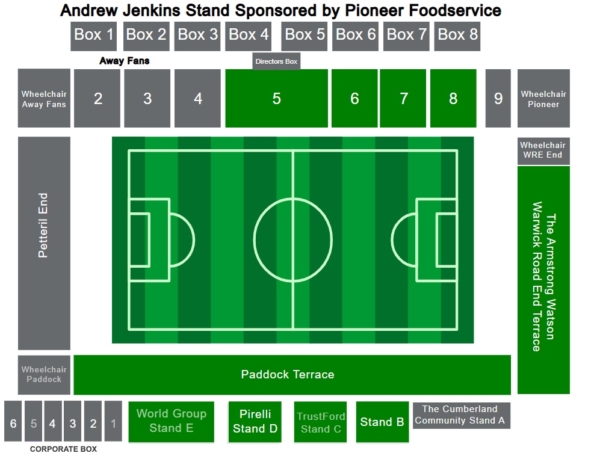
The away ticket office is located at the north end of what’s now known as the Andrew Jenkins Stand Sponsored by Pioneer Foodservice, just to the right at the rear of the ground and close to the away fans’ entrance. This year, away fans are housed in the uncovered terrace at the north (Waterworks) end of the ground, so don’t forget a raincoat! While this area is mostly standing, there are also 66 (unreservable) seats provided.
Ticket prices for the 2025/26 season are as follows:
- Adults – £23 (in advance), £26 (on the day)
- Senior (65+) – £20 (in advance), £23 (on the day)
- Young Person (18-22) – £17 (in advance), £20 (on the day)
- Junior U18 – £12 (in advance), £13 (on the day)
- Junior U11 – £9 (in advance), £10 (on the day)
- Family Junior* – £7 (in advance), £8 (on the day)
- U7 – £5 (in advance), £6 (on the day)
- Wheelchair & Carer – £20 (in advance), £23 (on the day)
*Up to two Family Junior tickets can be bought with each Adult ticket, or one with each Senior ticket.

Legendary Liverpool manager Bill Shankly took his first step in management in 1949 at Carlisle, where he stayed for 2 years.
How are they doing?
Carlisle had a miserable 2024/25, suffering a second successive relegation. They finished 23rd in EFL League Two with 42 points and 10 wins—six points ahead of troubled Morecambe, but still eight short of safety. Mike Williamson was dismissed in February after 25 games in charge and replaced by former Wales manager Mark Hughes, who was unable to prevent the drop. The club will hope to emulate their last—and only other—spell in the fifth tier, in 2004/05, when they bounced straight back via the play-offs.
Backed by ambitious US ownership, as well as undertaking a review of what caused the poor performance of the past two seasons, the club made several summer signings: Bevis Mugabi (defender, from Anorthosis in Cyprus), Sam Murray (left-back, Manchester United), Morgan Feeney (centre-back, Shrewsbury Town—returning to Carlisle after two years away), Josh Grant (midfielder, Wealdstone), Junior Luamba (forward, Salford City), David Ajiboye (attacker, Peterborough United—also on loan at Sutton United), and Regan Linney (striker, Altrincham, where he scored 25 goals in 2024/25).
The Cumbrians have made a very respectable start to their 2025/26 campaign, and currently sit in third place in the National League, behind Rovers on goal difference. However…a 5-0 humiliation by York City was followed by a 2-0 defeat by Rochdale last month, and it would be reasonable to note that the bulk of the team’s victories (like FGR’s) have been against teams that are not currently contesting the play-off slots or higher. None the less, this is a real six-pointer, a second consecutive top-of-the-table clash in Rovers’ league season – and depending on the result of Rochdale v Yeovil Town, either team playing at Brunton Park could go top of the league by the blow of the final whistle on Saturday.
The Gaffer
Mark Hughes arrived at Carlisle in February with the club in trouble and facing relegation, and after the transfer window had slammed firmly shut. Too late to impose any substantive change, under his leadership, the team won five of their final 18 games. His task now is clear: to significantly improve on that return and engineer a rapid return to the EFL.
Before coming to manage the Cumbrians, Hughes’ most recent managerial position had been at Bradford City, but before that he had managed several clubs higher up the pyramid – Southampton, Stoke City, QPR, Fulham, Blackburn Rovers and even Manchester City, where he replaced Sven-Göran Eriksson. However, his longest-serving managerial position was for the Wales national team, where he was in charge from 1999 to 2004.
As a player, Hughes was a formidable attacking midfielder. He scored 16 goals for Wales and 120 for Manchester United across two spells spanning 14 years. He also played for Barcelona, Chelsea, Southampton, and Blackburn Rovers, among other clubs. Carlisle’s ambitious ownership clearly believe his top-level experience is what’s needed to turn around Carlisle’s fortunes.
The Club
Carlisle United were formed in 1904, and for most of their existence – since 1909 – have played at Brunton Park. After initially playing in the Lancashire Combination and the North Eastern League, in 1928 they were elected to Division Three (North). Although most of the subsequent decades found them in either the third or fourth tier, the team spent 15 seasons in the Division Two between the mid-1960s and mid-1980s, their success peaking in 1974/75, when they spent one season in Division One. Although they finished bottom and were instantly relegated, three games into the season, having defeated Chelsea, Middlesbrough and Spurs, Carlisle were on top of English football. – somethat that not even Bill Shankly could have dreamed of when he managed the club as his first managerial role, although he had described their promotion to Division One as “the greatest feat in the history of the game”.
Carlisle United endured a turbulent spell in the 1990s under owner Michael Knighton, who had previously held a stake in Manchester United. Knighton boldly declared his ambition to take Carlisle into the Premier League—but things quickly unraveled. After controversially appointing himself manager, the club was relegated to the fourth tier. Their Football League status was saved in dramatic fashion in 1999, thanks to a last-minute goal by loan goalkeeper Jimmy Glass.
Relegation to the Conference finally came in 2003, making Carlisle the first club to have played in all top five tiers of English football. A revival followed, with back-to-back promotions lifting them to League One by 2006. They remained at that level until 2014, reaching the play-offs in 2007/08, before slipping to League Two in 2016/17. Promotion back to League One in 2022/23 brought fresh hope, but was followed by back-to-back relegations—leaving the Cumbrians once again outside the Football League.
The Town
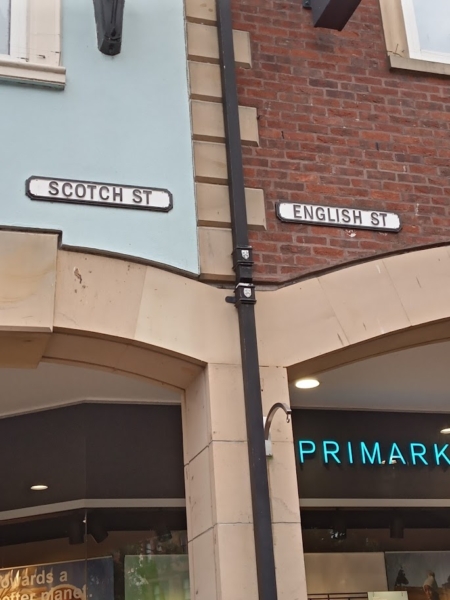
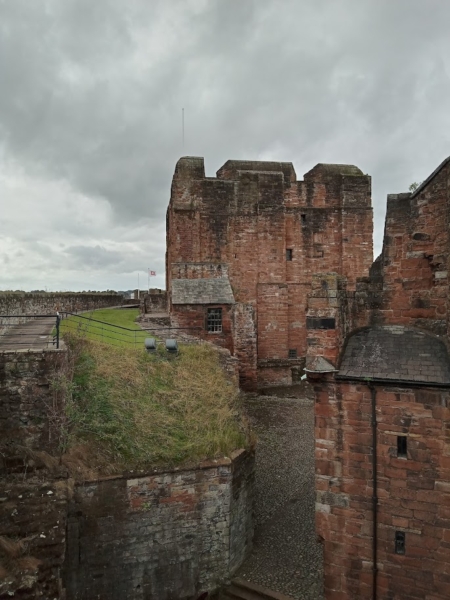
Carlisle is a fascinating place to visit, with a distinctive character shaped by its position as a border city with a long and often turbulent history.
Carlisle Castle —”One of the most besieged castles in England”, once home to the imprisoned Mary Queen of Scots, and now includes Cumbria’s Museum of Military Life
Carlisle Cathedral — at the heart of the city for over 900 years, including its famous starlight ceiling designed by Owen Jones
Tullie — Museum and art gallery
Hadrian’s Wall begins just outside the city, while the land-and-sea scapes of the Solway Firth are nearby, too.
A Curiosity of the Twentieth Century: The `Carlisle Experiment’ of Government-owned pubs:
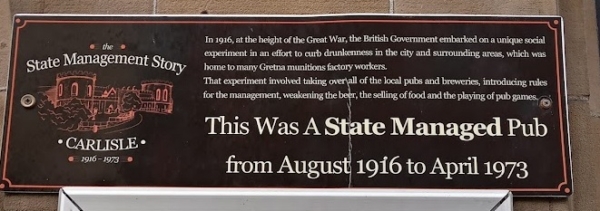
In 1915, concerned about the impact of heavy drinking on munitions production during World War I, the Government took a radical step: it nationalised pubs. The issue was deemed most pressing in the Carlisle–Gretna area, where construction of a massive munitions factory had drawn thousands of workers.
By 1916, the State owned all breweries and around 300 pubs across north Cumbria. The changes were sweeping—beer was watered down, prices were raised, advertising removed, and landlords were paid fixed salaries to discourage overselling. This bold social intervention became known as the Carlisle Experiment.
Surprisingly, it worked. Alcohol-related incidents dropped, productivity improved, and the scheme continued—albeit in a reduced form—until the 1970s. It was also believed to have inspired the design of many privately owned `improved’ pubs built across England between the World Wars.