
Hartlepool FC,
Victoria Park,
Clarence Road,
Hartlepool
TS24 8BZ
The Club
Hartlepool United are known by two nicknames: The Pools and The Monkey Hangers. The plural Pools harks back to the club’s original name, Hartlepools United, which reflected the two separate towns it represented—Hartlepool (the coastal headland area) and West Hartlepool (the more industrialised area, where Victoria Park is located). After the towns officially merged in the 1960s, the club eventually updated its name to Hartlepool United in 1977.
As for Monkey Hangers—that one’s rooted in local legend. During the Napoleonic Wars, it’s said a monkey washed ashore from a shipwreck off the coast. The locals, having never seen a Frenchman—or perhaps a monkey—allegedly mistook it for a French spy and hanged it. True or not, the story stuck, and Hartlepudlians have worn the nickname with a mix of humour and pride ever since.
The club mascot is a monkey named H’Angus, most famously brought to life by Stuart Drummond—who made national headlines when he was elected Mayor of Hartlepool in 2002 while still in costume. He went on to win two more terms, becoming the town’s first—and last—directly elected mayor before the role was abolished.
Two managers stand out in Hartlepool’s history. The great Brian Clough began his managerial career at the club in 1966, alongside Peter Taylor. And between 1989 and 1991, Cyril Knowles—“Nice one, Cyril”—led the team to one of its most successful periods in decades. Tragically, Knowles was diagnosed with brain cancer and passed away in 1991, and he remains a revered figure among fans.
A founder member of Division Three in 1921, Hartlepool spent the next 89 years yo-yoing between the third and fourth tiers, earning the dubious distinction of having to apply for re-election to the Football League a record 14 times—surviving each one. But in 2016/17, they finally dropped out of the league, finishing 23rd in League Two just as FGR went the other way. After three seasons in the National League, Pools clawed their way back via the play-offs—only to suffer relegation again two seasons later.
Travel to Hartlepool Utd
Hartlepool is located on the coast of County Durham, north of the Tees. It is a journey of about 250 miles from the Stroud area, taking between four and five hours by road if all goes smoothly.
By Supporters Club Coach – this is by far the cheapest and easiest way to travel. For information about Away Travel, including precise details of pick-up locations – look here. For this match, the departure times are The New Lawn – 7.30am, Sainsbury’s Dudbridge 7.45am, Stonehouse Brunel Way – 8am.
The prices for coach tickets to this match are as follows (Supporters’ Club members get a £3 discount): Adults £44, U-16 £25, U-11 £12
To book a seat with the supporter’s club discount, please call 0333 123 1889 on Monday, Thursday, or Friday at 11am to 2pm. Please try to book early.
By Car –
The postcode for car travellers is TS24 8BZ. There is a reasonable amount of parking near the ground as well as some pay-and-display parking that isn’t too expensive. There is also some street parking nearby. The ground is very close to the town centre.
By train – travelling by train from Gloucestershire to Hartlepool and back on the day is effectively impossible. The easiest way would be to get a train from Gloucester at 09.02, which, with one change at York, would get you into Hartlepool at 1.52pm. You’ve no option but to stay overnight, though. An off-peak return (valid for one month, but not before 9.30am on weekdays) between Gloucester and Hartlepool costs around £163, but judicious use of split ticketing and advance purchase tickets can reduce this substantially. Tickets from Stroud are more expensive, and there is engineering work and rail replacement buses involved for that part of the journal, so attempting to start the train journey there is not recommended.
The Ground
Victoria Park has been Hartlepool’s home since they were founded in 1908. It has a capacity of 7,865 and usually contains a crowd of up to 4,000 fans who aren’t afraid to make quite a lot of noise!

Recent Clashes with Rovers
The Pools’ most recent visit to Nailsworth was in August 2025, when a goal from Kairo Mitchell put Rovers’ 1-0 ahead, and kept them top of the league table, early in the season.
The Gaffer

Nicky Featherstone was appointed Pools’ manager, initially on an interim basis, on 12 October 2025, becoming – after Darren Sarll, Lennie Lawrence, Anthony Limbrick and Simon Grayson, the club’s fifth manager in the space of a calendar year (he was confirmed in post in December). And this despite a respectable mid-table finish at the end of the 2024/25 season and a lack of obvious humiliation early in the 2025/2026 one. Featherstone’s appointment at Victoria Park was something of a reunion: he had played for the team as a midfielder from 2014 to 2023 and as player-coach in 2024 to 2025, making over 400 appearances for the club during a period in which it was relegated from EFL League Two twice (and promoted there once). Indeed, only five players have ever made more appearances for the club. This is Featherstone’s first managerial role, but the nomination of such a club favourite is a clear indicator of a wish for stability that had recently been lacking.
What are they thinking?
How are they doing?
Pretty decently, but just frustratingly short of making a last-minute smash-and-grab on the promotion play-off places, like Southend did last year. New ownership, which took effect in late December 2025, has raised optimism a bit. In general results have been respectable rather than outstanding, with no very obvious highlights to pick out, and, a 4-0 defeat by Woking aside, not much in the way of lowlights either. For a club with one of the larger (and more enthuisastic) fan bases in the league, and one with a football league pedigree, there are reasonable grounds for hope of an eventual return to the EFL, just not quite yet.
The Badge

The badge, used since 2021 (when it replaced a complicated design based around a ship’s wheel orignally introduced in 1995), is a heraldic pun – a hart by a pool. The town has a seal depicting a similar image that is claimed to date back to 1200.
The Town
Hartlepool is in County Durham and is a seaside and port town on the north-east coast. Victoria Park is close to the railway station, the town centre, and the sea.
The name comes from a pool where harts (red stags) drank. With a bit of French influence after the Norman Conquests the town became Hart-le-Pool (the pool of the stags).
The area became heavily industrialised in the 19th Century with an ironworks and shipbuilding. By 1913, 43 ship-owning companies were located in the town, with the responsibility for 236 ships. This made it a key target for Germany in the First World War. One of the first German offensives against Britain in WW1 was a raid and bombardment by the Imperial German Navy in 1914. Hartlepool was hit with a total of 1150 shells, killing 117 people.
During this period there were 2 Hartlepools – ‘Old Hartlepool’ & ‘West Hartlepool’. They were finally merged in 1908. The town’s football club was then called Hartlepools in a bid to show it included both parts of the town. Local fans still refer to the club as ‘Pools’.
Loss of heavy industry and the docks meant the town became a byword for urban decay. In the 1990’s, the docks near the centre were redeveloped and reopened as a marina. The accompanying National Museum of the Royal Navy opened in 1994, is all centred in what is known as the Hartlepool Historic Quay. It’s an attractive area, a stone’s throw from the football ground.

The National Museum of the Royal Navy on Hartlepool’s historic quay.
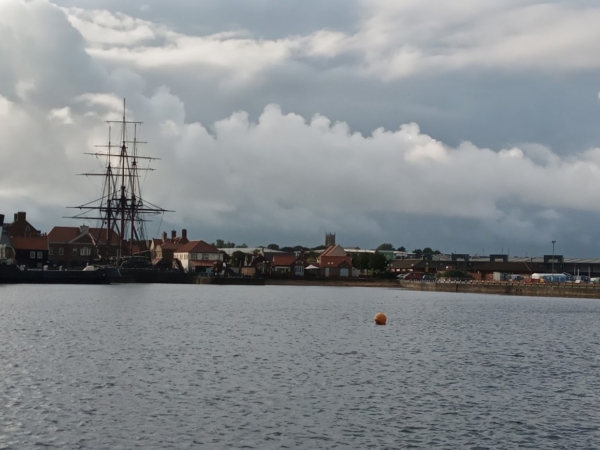
Hartlepool Marina
