
The Club
Rochdale AFC
Spotland Arena,
Sandy Lane,
Rochdale
OL11 5DR
Rochdale AFC still hold the distinction of having spent more seasons in the bottom tier of the EFL than any other club—fifty in total. In fact, over 95 seasons, the club had only ever played in the third or fourth tiers of English football. That long-standing pattern ended in 2023, when they were relegated to the National League amid financial struggles and a series of failed takeover bids. In May 2024, the club was bought by the family of local businessman Sir Peter Ogden, co-founder of IT giant Computacenter. Last season’s credible performance suggested the beginnings of a turnaround, and that seems to be continuing so far this season.

Peter Ogden, of the family that have owned The Dale since 2024.
Travel to Rochdale
Rochdale is to the north-east of Manchester (a little north of Oldham), historically in Lancashire, on the way out towards Leeds. It’s a road journey of about 170 miles from Nailsworth which is a journey time of 3 hours 10 minutes in normal traffic.
By Supporters Club Coach – this is by far the cheapest and easiest way to travel. For information about Away Travel, including precise details of pick-up locations – look here. For this match, the departure times are The New Lawn – 2:00pm, Sainsbury’s Dudbridge – 2:15pm, Stonehouse Brunel Way – 2:30pm.
The prices for coach tickets to this match are as follows (Supporters’ Club members get a £3 discount): Adults £35, U-16 £20, U-11 £10
To book a seat with the supporter’s club discount, please call 0333 123 1889 on Monday, Thursday, or Friday at 11am to 2pm. Please try to book early.
By Car –
Ground Post Code – OL11 5DR
Travel to Rochdale by car will take a little more than three hours from Nailsworth.
Car Parking
Parking close to the stadium isn’t especially easy. There is some street parking pretty close – try Willbutts Lane postcode OL11 5AY – but also a number of matchday parking restrictions. Oulder Hill Community School Matchday Car Park charge about £5 a car (a 10 minute uphill walk to the stadium) postcode OL11 5EF
There is street parking available, but it is further away from the ground due to a local residents’ parking scheme, so please check signage on lamp posts for restrictions
By train – Getting to Rochdale’s stadium by train is hard work, and for an evening fixture necessitates an overnight stay. Generally speaking there is one train an hour northbound from Stroud: with changes at Gloucester (or Cheltenham Spa), Birmingham New Street and at Warrington Bank Quay (or instead by staying on to Manchester Piccadilly and getting the free bus to Manchester Victoria, before picking up the train to Rochdale), you can be at Rochdale station within six hours or so. The stadium is a taxi ride, 40 minute walk, or a convoluted bus journey away (usually involving a change of buses in Rochdale town centre). It may be as easy to get the Metrolink tram from Manchester Piccadilly to Bury, and then take the 467 or (quicker) 468 bus to Spotland. A return ticket between Stroud and Rochdale (with the return portion valid for one month) costs around £128, but substantial savings (of up to one-half) can be made by judicious use of split and advance-purchase tickets.
The Ground
Spotland Stadium (known as the Crown Oil Arena for sponsorship reasons), with a capacity of 10,249, has been Rochdale’s home for over a century.
During the 1990’s and 2000’s, three new stands were built which transformed the stadium. The last of which to be built was the Willbutts Lane Stand (away fans are located on one side of this stand). The Sandy Lane End is the only remaining terrace, but it is now covered. Having had problems with drainage (the Pennine climate not helping), the club used the Christmas and New Year period to lay a new pitch, hopefully resulting in fewer matches being called off than has been the case in recent years.
Recent clashes with Rovers
Rochdale supplied Rovers with their first defeat in any competition of the season when they visited Nailsworth in October, with a header from Kyron Gordon making it 1-0. This also led to the Dale replacing FGR at the top of the league table, pushing Rovers down to second place.
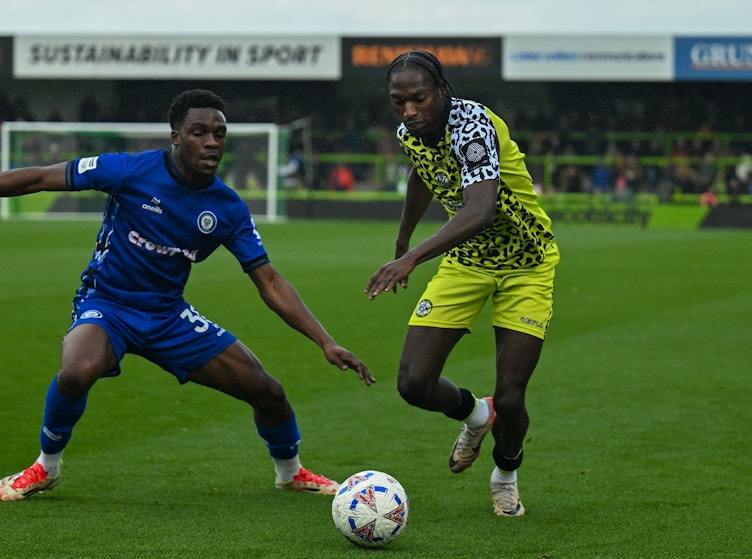
Rovers’ last visit to Spotland was in August 2024, and was an edgy no-score draw.
How are they doing?
Exceptionally well. In fact, and even with a couple of games in hand over most of their opponents, Rochdale are not only top of the National League, but currently have as many points (70) – in early February – as the sixth-finishing team (Halifax Town) had at the end of last season. The Dale have been in the uppermost part of the league table for pretty much the entire season, despite rainfall making heavy work of their (now replaced) old pitch and leading to postponements. The team’s defence has been particularly effective: by early February the team had conceded only 18 goals, fewer than any other team. Important results include a 2-0 victory over Boreham Wood in August and a 2-0 victory over Carlisle United in September. Conversely, leading teams who have beaten Rochdale include Rovers, Halifax Town, and most notably second-placed York City, who did so with an emphatic 4-1 scoreline.
The Gaffer
Jimmy McNulty became manager of Dale towards the end of the 2022/23 season, as their impending relegation from the EFL was about to be confirmed. (He had spent a spell as caretaker manager earlier in the season.) He was initially a player-manager, continuing in his role as a defender on the pitch. After having been through two relegations in three seasons, there was a clear hope that McNulty would steady the ship. In his first full season in charge, Dale’s first in the National League, the team finished in a respectable 11th position. The change of club ownership in May 2024 stabilized the club’s financial position, and in his second season in charge McNulty led to the club to a fourth-placed finish, being knockd out in the first round of promotion play-offs by Southend United.
Prior to becoming manager at Rochdale, McNulty had played for the team for eight seasons, making 197 appearances. He arrived at Rochdale from near neighbours Bury, having previously played for numerous other clubs including Barnsley, Tranmere Rovers, Scunthorpe United, Brighton and Hove Albion, Stockport County and Macclesfield Town.
What are they thinking?
The Town
Rochdale is a product of the Industrial Revolution. The manufacture of woollen cloth, was locally important as far back as the 1500s. At that time the textile industry was rooted in the domestic system, but towards the end of the 18th century mills powered by water started to appear. Water power was replaced by steam power in the 19th century fuelled by local coal and Rochdale became one of the world’s most prominent cotton processing towns. Although the town later fell on harder times, its industrial wealth generated civic pride and inspired some fine architecture. Rochdale Town Hall, a Grade I listed building i the Gothic Revival style of the late 19th century, is regarded as one of the finest municipal buildings in England. Nearby St Chad’s Church, parts of which date back to the 12th century, is another impressive construction that towers over the town centre. The Roman Catholic Church by the Railway station, in the Byzantine Revival style, and with a large dome (it is often mistaken for a mosque), is also noteworthy.
The Badge

The club’s crest is based upon the coat of arms of the former County Borough of Rochdale, with sections representing the woollen, cotton and iron industries that have all been important in the area. The Latin motto, “Crede Signo” – “Trust In This Sign” – is that of local nobleman and Civil War Cavalier general, Baron Byron (Sir John Byron) – himself known as “the Wicked Lord” and “the Devil Byron” whose successor as Baron was his great-nephew, Gordon George Byron, the romantic poet.
