
Barrow AFC
SO Legal Stadium
Wilkie Road
Barrow-in-Furness
Cumbria
LA14 5UW
The Club
Founded in 1901, the Club began playing competitive football in the Lancashire League (a reminder that Barrow, like the rest of Furness, was historically part of Lancashire) at its first home ground , known as ‘The Strawberry’. They then moved to a new ground at Ainslie Street in the town in September 1904. A further move to Little Park, Roose in March 1905 saw the Club enjoy their first success, winning promotion to Division One of the Lancashire Combination in 1908. The following year saw the Club move to its current home, Holker Street. Barrow’s crest tells a story – a submarine represents its shipbuilding heritage, particularly the building of submarines. The red rose represents its historic status as a Lancashire town. There is a visual pun: a bee impaled on an arrow (B-arrow), alongside the year of the club’s foundation and a football. As a football club Barrow spent about 50 years in the football league between 1921 and 1972 without any notable success, failing to be re-elected, their place in the league being taken by Hereford Utd. Almost the next 50 years were spent in non-league football with the club moving between the 5th and 6th tiers on a regular basis. In May 1990, Barrow became FA Trophy winners with a 3-0 win over Leek Town at Wembley thanks to two goals from Kenny Gordon and one from Club appearance and goal scoring record holder Colin Cowperthwaite. At the end of the 2007/08 season the Club won its way back to the Conference (as the 5th tier was then known), after an absence of 10 years by defeating Stalybridge Celtic 1-0 in the play-off final at Burton Albion’s ground. Although they fell back to the Conference North in 2013, in their second season they topped that division and won automatic promotion to the newly designated National League. At the start of the 2019/20 season, Barrow’s odds on winning the National League were 50/1. Defying these odds, the Bluebirds surprised everybody by leading the league until the season was curtailed by the COVID-19 pandemic and Barrow were awarded automatic promotion into the football league. However, and despite a couple of seasons in which Barrow finished in the top 10 places of League Two, it all went wrong in their sixth season back in the EFL, and they were relegated in last place back to the National League.
Travel to Barrow
By Supporters Club Coach – this is by far the cheapest and easiest way to travel. For information about Away Travel, including precise details of pick-up locations – look here. For this match, the departure times are Stonehouse Brunel Way – 7am, Sainsbury’s Dudbridge – 7.15am, The New Lawn – 7.30am.
The prices for coach tickets to this match are as follows (Supporters’ Club members get a £3 discount): Adults £44, U-16 £25, U-11 £12
For 26/27 season, the coach travel for the four long-range trips (Harrogate Town, Barrow, Carlisle United & Gateshead) will be subject to a minimum number of bookings, and thus may not operate.
The decision will be made two weeks before the game so that supporters have sufficient notice and so that we can avoid any cancellation fees for the coach.
If a coach does not operate to an away game, any supporter who has booked on will receive a full refund, and Travel Club members will also receive a pro-rata refund.
To book a seat with the supporter’s club discount, please call 0333 123 1889 on Monday, Thursday, or Friday at 11am to 2pm. Please try to book early.
By Train
The nearest station, Barrow-in-Furness is approximately 1/2 Mile away from the ground. On leaving the station, exit onto Holker Street and turn right. The ground will be on your left-hand side after a small roundabout at the top of Holker Street.
Realistically, a train is only a good option for this trip if you’re staying overnight, and travelling from Stroud is barely feasible on match-day. If you leave Cheltenham Spa by train at 7.40am you can get into Barrow for 1.02pm (changing at Stafford and Lancaster). A return ticket from Cheltenham Spa to Barrow (valid for one month) costs around £161, but by using split and advance tickets, you can reduce this cost by almost one-half.
By Car
The 240 miles will take almost 4 and a 1/2 hours by road.
Leave the M6 at junction 36 onto the A590 and follow signposts for Barrow. You will enter Barrow via Park Road and when you pass the fire station on the right, take the next left into Wilkie Road. The ground is on the right-hand side. Post code for Sat-Nav is LA14 5UW.
Car Parking
Unfortunately, Barrow are unable to offer official parking at the stadium due to limited capacity.
However, The Soccer Club – adjacent to Main Reception – offer a limited number of spaces at a small cost on a first come first served basis on matchdays.
Alternatively, there is free parking at Liberata – LA14 2UG (see photo diagram below)
There is plenty of street parking nearby.

Liberata – Free Match Day Parking
Disabled Supporters’ Information
Barrow Association Football Club | Guide For Disabled Fans (barrowafc.com)
The Ground
Holker Street is a wonderfully old-school ground overall, but with some much-needed (however imperfect) modern touches added during the club’s recent return to the English Football League. A Tuesday night under the lights at Barrow must be a classic English football experience, especially if a long journey to get there is involved. Most importantly for Rovers’ fans, the away area has been upgraded substantially since the first couple of seasons back in the EFL. When travelling in smaller numbers, away fans are accommodated in a raised tent-like structure at one end of the main (Brian Arrowsmith) stand, accessed by entrances 10 and 11 on the map of the ground, on Wilkie Road – currently known as the Acronis/Hudson Hill stand. While the stand does have a number of relatively thin stanchions blocking the view of the pitch, it is easy to avoid them with anything less substantial than a nearly-full turnout.


Ticket prices for 2026/27 are as follows:
Adult : £21
Senior 65+ : £18
18-21 : £18
14-17 : £8
0-13 : free
Tickets can be purchased online here.
There are no cash turnstiles on matchdays. However, the Ticket Office, located beside Main Reception, is from 10am until kick-off on Saturdays.
Last Time Round
The most recent occasion on which Rovers played Barrow was on a chilly Tuesday night in February 2024, when both teams were in League Two. It was the fourth game with Steve Cotterill in the technical area, and also his first victory as Rovers’ Manager – as well as Rovers’ first win in a league game since the previous October. The 2-1 result, with goals from Kyle McAllister and Manny Osedebe, was enough to lift Rovers off the bottom place of the EFL, but no further than the second-bottom place. While the win was an instant and important morale-booster (not least for the 69 Rovers fans who travelled to watch the game), and The Stroud Times were optimistic about what the result might presage, the ultimately the path to relegation had been set earlier in the season.
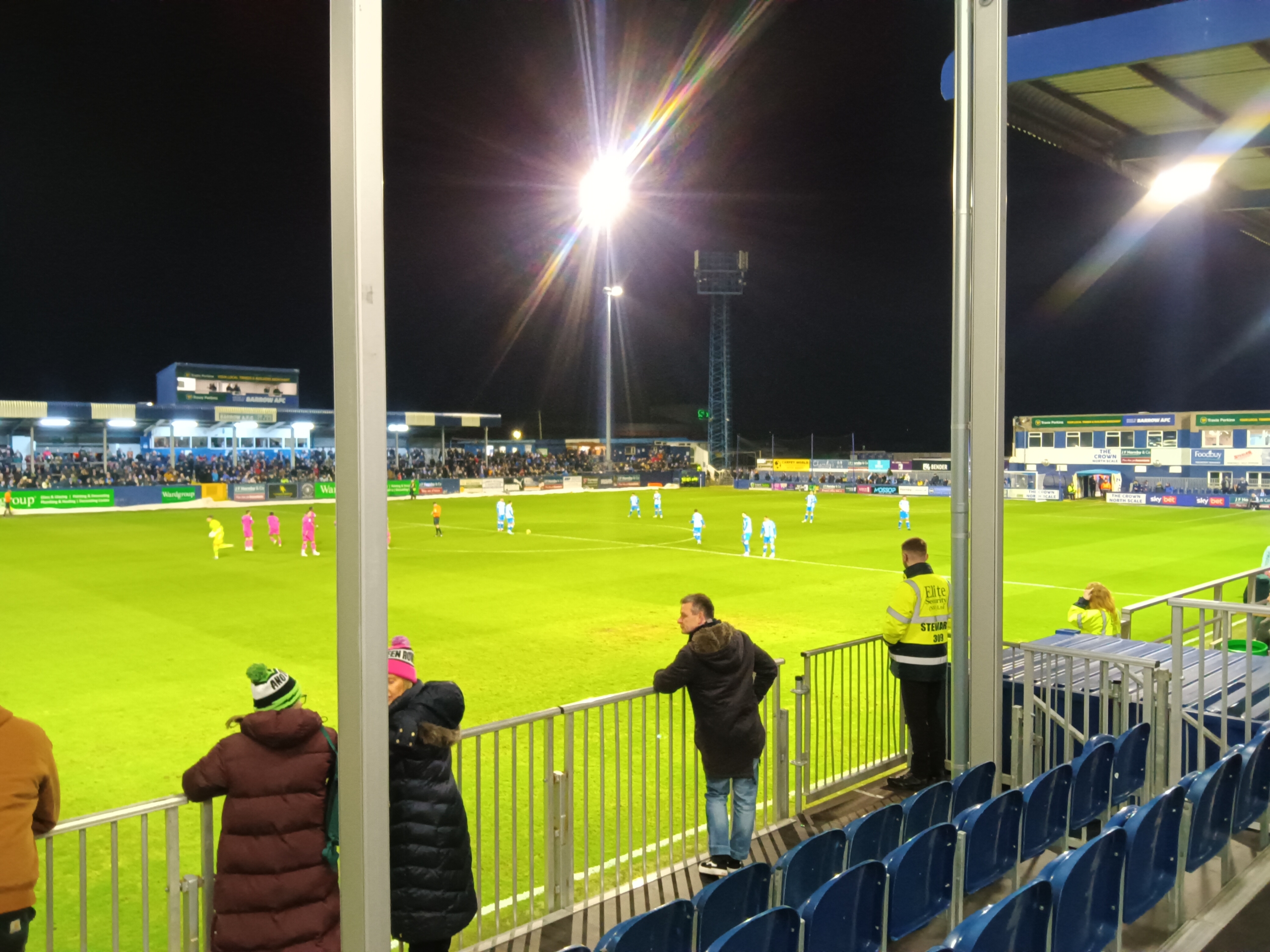
A small but loyal crowd of Rovers fans at Barrow in February 2024
How are they doing?
After fighting their way into the Football League in 2020 as “Barrow-celona”, admired for their silky passing style, under Ian Evatt’s management, Barrow struggled after Evatt accepted an offer from Bolton Wanderers before the new season began. They narrowly escaped relegation in their first two seasons in the EFL after half-a-century away, and got through a total of five managers during those two seasons – including Mark Cooper, Phil Brown and Michael Jolley.
Things picked up rather in 2022, and the team only narrowly avoided finishing in the promotion play-off places in both 2022/23 and 2023/24 – all under the management of Pete Wild. 2024/25, after Wild’s departure, was another season of two managers that ended in a lower-mid-table finish. 2025/26, however, was an incoherent season, to say the least – with the team getting through no less than five managers – including lower-league journeyman Dino Maamria. The incoherence continued on the pitch, with the team finishing bottom of League Two, having won only nine games all season.
In this context, some rebuilding was inevitable. First, a new manager, Adam Murray– most recently at newly promoted Kidderminster Harriers – was acquired. Centre-forward Dan Mooney and right-back George Walker both followed their former boss to his new club. Other incoming players included right-winger Ollie Crankshaw and midfielder Isaac Marriot from Altrincham, left-back Thierry Latty-Fairweather from Halifax Town, centre-forward Alex Reid from Hartlepool Utd.
As of late September success has been mixed: Barrow won just two of their first nine games, and must be looking to pick up form sooner rather than later.
The Gaffer

Adam Murray has managed Barrow since May 2026, following confirmation of the team’s relegation to the National League. In the previous season he had led Kidderminster Harriers to promotion from the National League North through the play-offs to the same fifth tier that his new club would also be playing in. Although his first managerial post was at then fourth-tier club Mansfield Town, and he has spent a time as acting manager at Barnsley (where he was the Under-18s’ manager) most of Murray’s management experience has been in the non-league game, with spells at Boston Utd, AFC Fylde and Eastbourne Borough.
As a player. Murray had a varied career as a midfielder. The only two clubs he spent a prolonged period at were those at which he started and ended his professional career – Derby County and Mansfield Town, respectively (this final term at Field Mill being his fourth spell there, when loan periods are taken in consideration). In between those bookends, he spent two seasons at Oxford Utd, and played for teams as far north as Carlisle Utd and as far south as Torquay Utd.
The badge
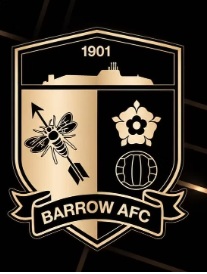
The Bluebirds are celebrating their 125th anniversary with a special home kit – in the team’s original colours of black and white stripes – with a special black-and-gold version of their crest to accompany it.
The crest in its way is a thing of beauty, combining specifically local elements with a visual pun: a Bee on an arrow – Barrow. Above that, the silhouette of a nuclear submarine (reflecting the continuing presence of BAE Systems – successors of Vickers Armstrongs – as a major employer at what is the largest shipyard in the UK) accompanies the date of foundation of the club, 1901. To the right there is a (usually) red rose of Lancashire – reflecting the traditional, pre-1974 county boundaries which gave that county a detached area of land across Morecambe Bay from the rest of the county, in Furness, and, of course, a football.
The Historic Transfer from West Ham to Barrow
It is quite widely known (in lower-league football fan circles) that, in the final year of Barrow’s first spell in the top four divisions of English football in the early 1970s, that a speedway track was built around the outside of the football pitch. Essentially intended to boost the income of the football club, its presence was not regarded with pleasure by the FA to such an extent that it was considered a significant factor in the club’s failure to gain re-election to the Football League in 1972, when Hereford Utd were elected to take Barrow’s place, after Barrow finished 22nd out of 24 teams in Division Four.
What is less appreciated is how – in an odd story of sporting franchising, the team that set itself up in Barrow in 1972 had moved to the town all the way from Romford in Essex, via a short spell at the West Ham Stadium (not to be confused with Upton Park/the Boleyn Ground), which in the 1930s had hosted a very short lived league football team, The Thames Association (who to this day retain the record for lowest attendance at a Football League game played with a crowd). What had been the Romford Bombers (hosted at the ground of then leading non-league team Romford), before a noise complaint forced the move to East London, set themselves up in Furness, initially as the Barrow Happy Faces (this name being related to a sponsorship deal with Duckhams Oil), before becoming the Barrow Bombers. The team left Holker Street without finding a new home in 1974, after only two years – but surely must count as the nearest thing to a transfer from West Ham that Barrow is likely to encounter.
The Town
Barrow might just be one of the most fascinating places that an away football fan in this league can visit. It’s mentioned in a popular fans’ song oft sung in the South Stand at TNL, but mostly because of its geographical remoteness – from anywhere, really. That isolation, alongside the town’s combination of still-functioning (if less so than previously) heavy industry and the proximity of stunning landscapes and wildlife, combined in some areas of the town with tenement housing that is more typical of Scottish cities than English towns create an atmosphere that is, in 21st century England, close to unique. The ruins of Furness Abbey dominate the landscape just outside the town, while if you cross to Walney Island, just a couple of miles from Holker Street, once you escape the industrial suburb, you might encounter seals offshore, alongside rare plants and an assortment of seabirds onshore. The Dock Museum tells much of the history of the town, with a particular regard for the shipbuilding there, which flourished particularly, in the 19th century, when the iron and steel works in Barrow were among the most productive in the world. The Royal Navy’s first submarine, Holland 1, was built in Barrow in 1901, and the town played an outsize role in building naval vessels that helped defend Britain during both World Wars. The first nuclear powered submarine in the UK, HMS Dreadnaught was made in Barrow, too, in 1960.
…and if that is not enough, the Lake District and Morecambe Bay are next door.

The Dock Museum, with part of the BAE site in the background.

Part of the ruins of Furness Abbey
